Sunday, April 22, 2012

Jeremy Lin as the New Face of Volvo


Jeremy Lin further serves to function as an icon for Asia through his new partnership with the Scandinavian luxury car brand Volvo, announced on Monday, March 20, 2012. In a two year agreement, Lin will function as the brand ambassador for Volvo in the United States, China, and Chinese-speaking language markets, according to Forbes magazine.

As stated in the agreement, Lin will not only function as the brand ambassador, but also appear in their advertising. The president of Volvo Cars China, Freeman Shen, stated, "Volvo Cars' choice of Jeremy Lin as the company ambassador derives from our shared ethos of passion, dynamism and progressiveness." Volvo hopes to launch its commercial advert campaign this upcoming summer as part of its efforts in a brand rejuvenation.

With Lin becoming the new face of Volvo, his image will be further entered into another avenue of mainstream media in the United States as well as China. The first Taiwanese/Chinese American to play in the National Basketball Association will flash across screens in advertisements unrelated to sports. Lin's presence will no longer be limited to the basketball arena and the New York Knicks. With Lin's appearance in Volvo adverts, the notions of the Asian population in America, China, and Taiwan have the potential to be slowly altered, causing an initial deconstruction of Asian stereotypes and the belief that Asians can succeed in the sport of their desire, specifically basketball in this case.  

This Volvo partnership marks the first major sponsorship deal for Lin, since he came off the bench in February and won a string of spectacularly-performed games for the New York Knicks. That being said, controversy obviously surrounds this deal due to its late timing and the short-lived fervor of "Linsanity." While Lin clearly benefits from this deal, the true question lies in whether Volvo will benefit. A quirky blogger discusses Volvo's decision and creates five potential tag lines for Lin and Volvo, including "Volvo: Drive into traffic with reckless abandon." Regardless of the uncertainty surrounding Lin and his career, this Volvo contract allows Lin's image to continue to survive and influence China and Taiwan extensively, hopefully functioning as an encompassing icon for Asia.

-Katharine James

Wednesday, April 18, 2012

An Asian-American Breakthrough


Sports fans everywhere are caught up in the mania surrounding New York Knicks point guard Jeremy Lin. But Lin’s impact is most personal, and most satisfying, among a subset of Asian Americans: those who, like Lin, grew up with a true passion for basketball, but are often stereotyped on playgrounds, in pick-up gyms or in recreational leagues as guys who cannot really play the game. Now that one of their own, Lin, has made the NBA – he’s not only Asian-American, but a guard, and not a seven-footer like Yao Ming — these Asian-Americans hope that Lin can change views in a place where race or ethnicity has always affected behavior and mindset: the basketball court.

Asian-American hoopheads hope that Lin’s example will encourage more Asian-American kids to pursue their basketball dreams. “There’s nothing wrong with being engineers, doctors or lawyers,” comicbook artist Bernard Chang told Time Magazine. “I just think we should be represented in balance. Sports like basketball are a huge part of our culture. Success will help us stake our claim as Americans.” 

There have been, in recent years, many Asian American pioneers in the public eye who’ve defied the condescendingly complimentary “model minority” stereotype: actors like Lucy Liu, artists like Maya Lin, moguls like Zappos CEO Tony Hsieh. They are known, often admired. But Lin is something new: an Asian American whom millions of other Americans want to be.

“He’s like our Obama,” one Asian-American, who professionally works in the technology industry but plays recreational basketball on the weekends, told Time, referring to how Lin is beginning to break stereotypes about Asian-Americans. 

Their embrace of Lin has made millions of Asian Americans feel vicariously, thrillingly embraced. Not invisible. Not presumed foreign. Just part of the team, belonging in the game. It is felt like a breakout moment: for Lin, for Asian America and, thus, for all of America.

Identity in America is complicated but it is also simple: it is about whom you identify with and who identifies with you. Lin is the only Asian American in the NBA today and one of the few in any professional U.S. sport. His arrival is surely leading other talented Asian American athletes this week to contemplate a pro career. Just as surely, though, it is leading many non-Asian non-athletes to expand their identities; to redefine, just by their rooting interest, “American.”

With Lin’s rise, there has been a swelling, collective feeling that Asians are no different from the other people they see on national TV, almost exclusively white and black. Jeremy Lin provides a source of potential within us, that we all house the talent and skill to be great, no matter our religious or ethnic background.

The New York Times' Michael Luo wrote about the inspiration Lin provides to young Asian-Americans, who have had a dearth of role models in major American sports. (Stars like Ichiro and Yao Ming are not Asian-American, but rather full Asian.) Consider this: Asian-Americans are now represented at every level of the NBA, from the court (Lin) to the sidelines (Eric Spoelstra, who is Filipino-American) and the front office (Rich Cho, the Bobcats assistant GM and former Blazers GM, who is Burmese-American). The NBA's world-class diversity continues


-Rayna Linowes

Lin Among the Most Influential People of 2012, says Time Magazine


Jeremy Lin, who one year ago was a benchwarmer for the Golden State Warriors and seemingly had no future as a professional basketball, is now a part of a very prominent list of individuals that includes Warren Buffest, Barak Obama, Matt Lauer and who else, Tim Tebow. It is Time’s ninth annual Top 100 Most Influential People in the World list, and Lin has the distinguished honor of being named with such amazing people in the world today.

The people on this list are not just the most widely known individuals in the world, but they are people who can change lives and evoke emotions just with their actions or words, and the fact that Lin is among them is not just a testament to his play as a basketball player, but his ability to influence others to act as he has.

The three-paragraph blurb on Lin’s inclusion in the list begins with the central theme of his greatness. Arne Duncan, who is the U.S. Secretary of Education, says “Jeremy Lin's story is a great lesson for kids everywhere because it debunks and defangs so many of the prejudices and stereotypes that unfairly hold children back.” All this is true. Jeremy Lin has done the unthinkable, and now he has the power (and the ability) to transform not only the NBA but also the misconceptions and stereotypes that surround basketball.

What this list means for Jeremy Lin’s future goes way beyond his marketability and NBA career. He can now do what few have been given the change to do: change the way people think. Schemas have caused society to associate Asian and Asian Americans with good grades and computers, not sports. The fact that Lin has received this honor by his play on the court and not anywhere else also proves that he has a bright future as a humanitarian and life-changer.

Duncan finishes by saying “I don't care whether you are an Asian-American kid, white, black or Hispanic, Jeremy's story tells you that if you show grit, discipline and integrity, you too can get an opportunity to overcome the odds.” Lin can prove to the world that your race does not define you as an athlete, and certainly not as a person. 


-Tyler Greenawalt 

Monday, April 16, 2012

Chinese and Taiwanese Social Identification of Jeremy Lin


Jeremy Lin's rise to fame within the last couple months has led to both Chinese and Taiwanese fans laying claim to this new star, generating a social debate within the media about who Lin represents in Asia. This media discussion specifically brings to light the various nuances of widely recognized race and gender media theories of ultimate attribution error and social identity theory. While ultimate attribution error pertains to in-group and out-group dynamics, social identity theory surrounds the concept that individuals selectively choose certain social intergroup dynamics. According to Harwood and Roy in "Social Identity Theory and Mass Communication Research," group members constitute crucial elements of the self in that they combine societal intergroup dynamics to influence thoughts and actions. Relating to Jeremy Lin and Asia, media theories apply on a two-fold basis: Lin's identification with a certain Asian in-group and Taiwan and China's claim to Lin himself.

Throughout his recent career success, Lin has remained diplomatic in an attempt to avoid controversy by emphasizing both his Taiwanese and Chinese heritage. China and Taiwan are extremely interwoven cultures with the majority of the Taiwanese population ethnically Chinese and China's political claim over Taiwan. This intimate relationship leads to a confusing and complex creation of various in-groups and out-groups throughout both Taiwan and the mainland of China. While Lin was born in the U.S., his father's family has been in Taiwan for several generations and his great grandmother emigrated to the U.S. from Zhejiang, China during the Chinese civil war from 1927-1950. As one could argue, Lin through his direct and continuous lineage in Taiwan belongs solely to the Taiwanese ethnic in-group. In a Wall Street Journal interview in February Lin stated, "I love going to Taiwan and I'm going to be there every summer, so to all the Taiwanese fans I can't wait to them all again this summer."  From this statement and others, it is clear that Lin closely identifies with Taiwan. However, an individual's social identification is usually not limited to one group, and more commonly consists of multiple groups spanning across ethnic, cultural, and social genres. Therefore, placing Lin in either the Taiwanese or Chinese in-group is ultimately naive. This new basketball superstar has the ability to identify and support multiple groups nationally and internationally. One cannot obviously forget his strong, and probably most dominant, identification with America (being American-born, a childhood resident of San Francisco Bay Area, a graduate of Massachusetts's Harvard, a former California Golden State Warrior, a New York Knick's basketball player, and so one and so forth).

The true issue, however, arises in China and Taiwan's individual claims of Lin as solely their own. Since Lin's quick success in February, every major newspaper in Taiwan has placed Lin on the front page and the local malls have taken to broadcasting Knicks games in public spaces. Lin has become quickly ingrained within Taiwanese society, causing the creation of new Taiwanese terms to support the Lin frenzy as well as various industries equating Lin's game-winning shot to industry trends. Additionally, the mainland of China has jumped on the bandwagon, assimilating Lin as one of their own. Gaining over a million fans on the Chinese social network site Weibo, Lin has also been extensively covered on Chinese television stations (although, the occasional censorships referencing Lin's religious preferences should not be forgotten). These claims of Lin belonging to both Taiwan and China groups should ideally function advantageously with the potential of Lin to become an encompassing icon for Asia, which could ultimately eliminate the geopolitical tensions between countries, specifically the island of Taiwan and the mainland of China. However, this potential has yet to develop. Angry debates just rally back and forth between Taiwan and China of who Lin represents. Lin's injury and any other possible downfalls of this extraordinary athlete could cause a strong ultimate attribution error with each cultural group blaming the other and its characteristics for Lin's demise, serving to only create further fissures within the tenuous relationship of China and Taiwan.

Jeremy Lin provides a real-world example of two prevalent media theories discussed throughout the semester. Lin and the Asian debates surrounding him enhance the relevance of these theories, highlighting specific factors that pertain to each element of social identity instances and ultimate attribution error. Lin, like many others, associates and assimilates into various social identity groups that uniquely pertain to his ancestry and cultural upbringing.

-Katharine James

The Uncertain Future of Jeremy Lin


The future of Jeremy Lin after his potentially season-ending surgery was explored in a recent blog post on Grantland. While the article dealt mostly with where in the NBA Lin could go if when he hits free agency this offseason, it did touch on some notable points with the future of the February sensation.

Jay Caspian Kang wrote about possible destinations for Jeremy Lin if he didn’t return to the Knicks, but eventually settled on the fact that “most likely, Lin will understand that his best endorsement and career potential lies in New York.” The bright lights and celebrity status that has been adorned on such athletes as Derek Jeter, Eli Manning, Mark Sanchez, and now Tim Tebow have only been attained as easily and as quickly because of the fact that they play in quite possibly the most-watched city in the world. It is certainly the most covered by the media.

But how will the city that never sleeps deal with a superstar of Asian decent? The future of Lin goes way beyond his offseason destination and more into his acceptance as a celebrity in New York, if he stays.

ESPN and other media has given the Jeremy Lin story so much coverage that it is beyond any concession ever heard of in the history of white news. No matter if you are a fan of basketball, the media, Asian news, or all three, you know Jeremy Lin’s name, his background, and what’s happening to him. But is that only because he has stayed in New York? What if he went to teams with smaller media coverage such as Toronto or Indiana or New Orleans?

The future of Jeremy Lin not as a basketball player but as a symbol for breaking Asian stereotypes in sports lies in where he lands as a basketball player. It’s interesting that his professional career will dictate how his presence affects the basketball community. Either he can fade into the background like the few Asian basketball players have done in the past years, or he can shoot ahead and become a symbol for other players of Asian decent to come out of the woodwork.

Before African American players became the more dominant race in basketball, it was almost unheard of for black athlete to play in professional sports, let alone basketball. Now, as players have become more and more accepting of this fact and have seen a more frequent showing of this fact, it is more of a normality for black athletes to perform at a higher level then most races because they have been doing so for a longer time. Athletes of Asian decent, however, have not seen an acceptance of greatest at a professional level, except for a few exceptions such as Yao Ming in basketball and a few players in baseball. But Jeremy Lin’s incredible fast rise to stardom due to his unique style of play, his spot on a New York City team’s roster, and of course his Asian decent has given hope for yet another break in a social stereotype that has developed over the years.

Unfortunately, the recent injury to Lin has derailed that rise, for now. He can still make a difference off the court to help break the norm as well as prove he is still a great player next season when he returns from injury. However, if he is not in a city or on a team with a large media following, it is entirely possible he drops out of the spotlight again.

-Tyler Greenawalt 

Monday, April 9, 2012

Hegemony in the Jeremy Lin Saga

We have discussed in class the generic stereotypes that stigmatize Asian men throughout American media.  They are not "manly", they are not smooth around women, they are not well-endowed, if you will, down below, and they tend to always be the smartest man in the room.  Granted, these stereotypes do not get brought into the sports realm all too often, but that is because Asians have found little to no success in American sports (save baseball, in which Asians excel).  Which is why Jeremy Lin's emergence over this NBA season has been a culture shock to the American media.  They've never had to cover a figure such as Lin, with Yao Ming having the only relatedness.  But even Yao carried typical Asian stigmas in the eyes of sports fans that may have affected the way he was covered.  Sure, he was talented, but he barely could speak English and he was freakishly tall and goofy.

Now America has been exposed to an Asian that was born in the States, is not a physical anomaly, and seems to carry himself with extreme poise in front of the camera.  And his popularity and aura have created a "Jackie Robinson-like" experience for sports fans.

The question I pose is this - Has Jeremy Lin been an example of American media conceding hegemonic control  to Asians in American sports, or has Lin (like Jackie Robinson) blazed a trail that has seemingly broken typical stereotypes?

When our class read White News, one of the main theories discussed in the book was that when media portrays minorities for their customs or cultural beliefs, it can reinforce stereotypes of that minority.  Coverage of Lin's 2011-2012 season with the New York Knicks has been all over front page headlines, but has it reinforced stereotypes?  We have shown you examples throughout this blog of racist remarks regarding Lin, such as the highly-criticized ESPN headline, and you have also seen video coverage from SNL of how Asian jokes that could be seen as insensitive are seemingly being taken as a joke, when compared to racist remarks geared towards other minorities.

But why is a racist remark aimed at Kobe Bryant 'outdated', while remarks about Lin are being used daily?  Is it because Asians are newer and more of an anomaly on a basketball court than African-Americans?  If Jeremy Lin were to usher in an influx of Asian basketball players, would jokes about him become outdated as well?

These are the questions that I pose, and it seems to me that, for the most part, many of the stereotypical remarks have come in satire.  Everyday reporting on Jeremy Lin has spoke highly about his talent on the court and his character off the court.  Remarks about his Asian descent, unless being the main topic of the article, have been mentioned very little.  However, I find that this lack of pointing out Lin's descent is a concession in itself.  News reporters know that being an Asian-American is arguably the first thing that comes to mind in their readers, and thus, continue to churn out stories about him, all the while claiming that 'race is not the issue'.  If stories regarding Lin subside while his talent on the court remains at a high level, then Jeremy Lin has found his place in basketball without his race being the first thought.  But until then, his popularity will stand on the platform that he is a mere anomaly in the NBA and his mystique is fueled by his race rather than his ability to make a sweet, no-look pass or hit the game-winning 3-pointer.

- Shaun Loughlin

Monday, April 2, 2012

Creation of New Words in Both English and Chinese

Jeremy Lin's "enrichment" of language through the development of terms, such as "Linsanity" and "Linterest," is not limited to English. Five new Chinese puns have evolved as well!

Click here to see the five new Chinese words...

-Katharine James

Taiwanese "Linterns": Second Consecutive Summer


Jeremy Lin is scheduled to coach a basketball camp in Taiwan upon the conclusion of the NBA season, according to the China Times. Similar to his coaching last summer in Taiwan, Lin will personally design the program, which will be tailored to fit the needs of young players.

This summer camp could possibly lead to a development of a similar social identity amongst the kids who participate in the program...

-Katharine James

China's Reaction to "Linsanity"


Widespread criticism on China's reaction to the overnight popularity of the Asian American basketball player from Taiwanese descendant, Jeremy Lin, has cropped up throughout various news organizations in the United States. Debate surrounding Chinese censorship of Lin's religion and Lin's ability to act as an encompassing emblem for all Asians continue to be heatedly discussed.

With his almost instantaneous stardom, Lin has taken over social media, with his official Twitter page having just under 700,000 followers and his page on the Chinese social network, Sina Weibo, gaining over a million followers. Through his raw talent and aid from social media, Lin has become an international symbol amongst America and Asia, reigniting the passion for basketball amongst Chinese fans that faded with the retirement of Yao Ming.

However, with a serge of popularity in Asia, China has purposefully framed their media coverage surrounding Jeremy Lin. "Linsanity" has spread to Lin's ancestral homeland of Taiwan where dozens of fans gathered around a TV at 8a.m. in a Taipei bar on February 15, 2012 to watch the New York Knicks play the Toronto Raptors. Fans claimed Lin as one of their own, as reported by The Christian Science Monitor. While this game was broadcast live in Taiwan, fans on the Chinese mainland could not catch Lin playing on the state-run China Central Television (CCTV) sports channel. Instead, the government aired a taped European soccer game. The Financial Times attributes this apparent censorship of Lin by the Chinese government to Lin's outspoken Christianity or the tendency of fans to waive Taiwanese flags in a crowd of Lin fans. Since 1949, China and Taiwan have had a tenuous relationship with Taiwan considering itself an independent nation and the Chinese Republic considering Taiwan a province of their nation, which could possibly be attributed to China's reluctance to air Knicks games. Further, CCTV did air a segment of Lin on February 13, 2012 that featured brief comments of a New Yorker applauding Lin for his faith. However, the line was quickly censored later, as reported by the Financial Times. For a government officially atheist, this action by the Chinese government seems slightly odd. Since the 1970s, the government has tolerated open displays of Christianity. Perhaps, due to Lin's enormous popularity, the government does not want the entire nation to mimic their new icon through the adoption of the Christian faith. It seems the apparent openness of the Chinese government does not truly exist. Regardless of their reasoning, these instances of censorship highlight the Chinese government's engagement in gatekeeping, limiting access of the Chinese population to Jeremy Lin.

The true question lies in Jeremy Lin's ability to bring China and the island of Taiwan together. Can Lin function as an encompassing icon for all of Asia? Regardless of his current injury removing him from playing for at least the next six weeks, I believe Jeremy Lin still has a strong potential to bring cultures together. Within the month of February, the English-language news outlet China Daily has extensively covered Lin, celebrating him as an icon for all of Asia. All sports athletes, specifically basketball ones, have the ability to unite people under an umbrella of support and nationalism, especially for a country lacking a plethora of them. Through the effects of the cultivation theory, people immersed in social media will all develop a unifying support for Jeremy Lin and basketball, regardless of their nationalities or countries of origin. Further, Lin, a 6'2'' Harvard economics graduate, has starkly demonstrated that athletes of Chinese descent can succeed without the aid from the rigorous state-sponsored sport system, which Yao Ming was previously a member. This statistic could serve as an incentive for Chinese's sports officials to renovate their antiquated sports system more rapidly. With the implementation of a similar sports system to that of other countries, Asia could unite under a common goal of producing successful basketball athletes, potentially forgetting their governmental divides.

-Katharine James

Saturday, March 31, 2012

BREAKING NEWS: Jeremy Lin Out for Rest of Regular Season With Knee Injury


The New York Knicks say Jeremy Lin is having left knee surgery and will miss six weeks, likely ending his amazing breakthrough season.

The team announced Saturday night that Lin had an MRI exam that revealed a small, chronic meniscus tear.


- Rayna Linowes

SNL Skit Takes on "Linsanity"


Saturday Night Live addresses the breakthrough of "Linsanity" and the overuse of Lin puns and racially insensitive statements made by some of the media as the Asian-American point guard gained national prominence.

It's opening skit brings to light the issue of stereotypes.

- Rayna Linowes

The Jeremy Lin Effect: An Unprecedented Story

Before the New York Knicks, Jeremy Lin was nothing more than a Harvard graduate chasing his dreams. Yet, over night, he became a sensation. He is more than a just a good basketball player, he is a movement and a few weeks back, the biggest and most buzz-worthy thing in sport.

Jeremy Lin is the first Taiwanese-American to play in the NBA, a sport league where 76% of the players are African American. Lin’s story rises above the traditional sport story. His sudden rise to stardom has triggered a massive cultural and economic phenomenon. 

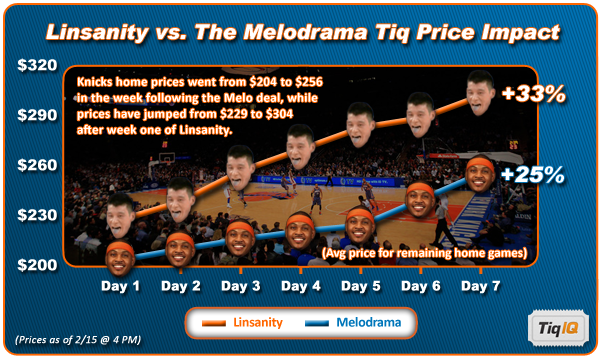
After one week of Lin's phenomenal performance on the court, the Knicks have seen a difference throughout their franchise. Ticket prices, for instance, are rising an unmeasured amount. As shown below, the week following the Carmelo Anthony trade last season, the average price for Knicks tickets jumped twenty-five percent (from $204 to $256) according to TiqIQ. Jeremy Lin has had an even larger effect. Home game ticket prices increased on average thirty-three percent (from $229 to $304). Fans love a great Cinderella story.


A week after his first big performance on February 4, Jeremy Lin was just named as the Eastern Conference Player of the Week, after picking up the same honor in the NBA D-League.  Forbes says that Jeremy Lin “is the fastest growing athlete brand in the world”. He even received a shout-out from Phoenix Sun's two-time NBA MVP point guard, Steve Nash: 


 In his first week of stardom, "Lin" has been mentioned more than 401K times and his following increases daily

It is said that "Linsanity" is the reasoning behind ending MSG's and Time Warner Cable's 48-day cable dispute
Forbes noted that since Feb. 4th MSG’s stock price has increased from $29.32 to $31.15 February 10th, or 6%, adding $139 million to the company’s market value. During the same period the S&P 500 has gone up less than 1%.

On February 13, Bloomberg reported that Jeremy Lin’s jersey has been the number one overall selling jersey on NBA.com, since February 4. 
Knicks apparel accounted for five of NBA.com’s top ten selling items.


- Rayna Linowes

An Inexcusable Mistake


"Chink In the Armor" - ESPN, the worldwide leader in sports, released this story headline late Friday night following the Hornets win over the Knicks. Some shrugged it off, many were angered and most found it hard to believe that the use of a such a loaded word was used on a prominent sports site. ESPN quickly released a formal apology and the fired ESPN editor explains that he was not attempting to make a joke. Lin decided it is better to let go of the issue than to make a big deal about it. In fact, on March 28, Lin met with the fired ESPN headline writer for lunch to discuss the incident, their accomplishments, and their faith in God.

However, the Asian American Journalists Association fired back in response to the headline:


AAJA to ESPN: Saying 'Chink in the Armor' Is Inexcusable

Dear ESPN:

New York Knicks guard Jeremy Lin had a bad night Friday. Regrettably, so did ESPN. Using “a chink in the armor” to describe Lin’s poor performance was inexcusable.

We at the Asian American Journalists Association (AAJA) find it hard to fathom how such an offensive headline appeared on your publishing platforms. The phrase was even spoken on-air.

We are glad ESPN has recognized its mistake, and we appreciate the quick apology for the transgression.
 Many people, not just in Asian American communities, are shocked that a news company with a long tradition of excellence would use a racial epithet. It's particularly galling because of the weeks of discussion about Lin, his heritage and even the wave of outright racism surrounding his stardom.

We are particularly concerned that an organization as large as yours did not have the proper checks in place to prevent the mistake. It is hard to fathom how editors on so many of your platforms failed to uphold your normally high standards.

Of course, it disappoints us to see one of our most valued and committed partners in diversity stumble. As you well know, this incident does not live up to the Leadership in Diversity Award that AAJA bestowed on ESPN in 2010. But we trust that you will transform this incident into a teachable moment.

We understand and appreciate that the offensive headline has been removed. But that's not enough. We would like to understand how it happened and what actions are being taken by ESPN to make sure such missteps do not recur. Your internal review could be instructive for others in our industry who want to improve the systems they have – or need to put in place – to ensure that fairness, accuracy and good taste are reflected in the news coverage of our communities.

As always, AAJA stands with you in our shared mission of diversity in America’s newsrooms, and we welcome an opportunity to discuss how we can help you and your employees treat our communities with the fairness and respect they deserve.

Sincerely,
Doris Truong, AAJA National President
Bobby Caina Calvan and Jam Sardar, AAJA MediaWatch Co-Chairs

- Rayna Linowes 

Wednesday, March 28, 2012


How do you feel about this video?  What types of stereotypes does this reinforce?  Taken from Jeremy Lin's YouTube page.

- Shaun Loughlin

The Future of Lin Off the Court


The future of Jeremy Lin, unfortunately, is also linked to the success of the Knicks. After the season is over, the only way the media and the public will remember Lin as another more than a professional basketball player if a) he and the Knicks make a deep playoff run or b) he does something that creates another media boom.

Since the former will probably not happened, Jeremy Lin will look to make a splash off the court. He has already done so with his new Volvo endorsement. According to the Huffington Post, Lin has become the worldwide spokesman for the Chinese-owned company, focusing on the Asian market. He signed a two-year contract with Volvo and will probably plan to sign more endorsement deals, particularly with Asian businesses.

Lin’s connection to the Asian world runs through his family, not basketball. However, Lin can make a huge impact in Asia with his basketball connection. The NBA has always tried to bring in more Asian players into its league, but has been relatively unsuccessful. But with Lin at the helm, the NBA can finally gain a large following in the largest continent in the world. When Lin played Toronto on Asian Night back in February, tons of Asian fans came out to support someone who they finally have a ethnic connection with.

While Lin’s play has not been as spectacular as it had been when he first stepped onto the court back in February, his off-the court future doesn't necessarily have to be connected to the Knicks. While ESPN and all the other sports shows will only follow Lin when he plays well. If Lin takes his success on the court to an off-court issue, his future not only as a professional basketball player but also as a media symbol will rise, much like Yao Ming’s did during his prime years.

-Tyler Greenawalt

Linsanity Versus Tebowmania


Even though Knicks winning streak with Lin has ended, the “linspiring” “linsanity” continues. Every time I turn on ESPN it seems the anchors are either talking about Jeremy Lin or comparing him to Tim Tebow. While both Tebow and Lin have run amuck not only on TV but also in America (and in the case of Lin all over the world), the two phenomena are inherently different.

Mr. Lin said it himself when he was asked about comparing his story to Tebow’s: they are not comparable. Yes, they both play tremendously in the fourth quarter and have led their teams to improbable winning streaks, but you can say the same for Tom Brady or Kobe Bryant.

The first and more obvious difference between the Lin and Tebow sensations is of course the hardest to avoid: race. Tebow is white and part of the dominant racial class, while Lin is not white and therefore not part of the same racial class. Now, this is not the most important difference, and I don’t believe it should be the main one. However, it is a difference that needs to be explored in order to separate the two stories. Lin plays a sport that is dominated by whites and African Americans. Before Lin started a few weeks ago, the only basketball players of Asian descent I could name were Yao Ming and Yi Jianlian. Out of those two players, one (Yao) is retired and the other (Jianlain) just isn’t good. Now, Lin is being portrayed as a superstar, and bringing in fans that the NBA hasn’t seen since Yao Ming was at his peak. While Lin’s race shouldn’t and doesn’t play a large role in his game, I think it is important to note because it does make his story much more different from Tebow’s story.

The difference between Lin and Tebow dates all the way back to high school. Tebow was a highly recruited quarterback that went to a huge football school in Florida. Lin played basketball in California and led his team to a Division II state title his senior year. However, Lin was only guaranteed spots at schools like Brown and Harvard, where he wouldn’t even get an athletic scholarship. Tebow had an illustrious career at Florida, winning national titles and Heisman trophies. Lin had a great career at Harvard, but it was Harvard, and he never went to a NCAA tournament. The Denver Broncos drafted Tebow in the first round of the 2010 draft. Lin went undrafted the same year in the NBA draft.

Tebow was supposed to succeed, well, at least more than Lin. Scouts and players said Tebow was not an NFL quarterback, save for Skip Bayless. However, no one doubted his will to play, his ability to play, or the fact that he was an athlete. Lin, on the other hand, was never supposed to succeed. He was an NBA journeyman until finding his niche with the Knicks. Basically, Tebow had much higher expectations than Lin because of who he was and how he grew up. However, Lin has exceeded any expectations he had, and more.

The final and most important difference is the level of play between these two players. Both have lifted mediocre teams to new heights, but Lin has been way more consistent throughout the entire game and has almost single-handedly led the Knicks to victories. Tebow had help. His defense played very well during that stretch of seven wins and the running game was the best in the league. With Lin, he did everything: he scored, he passed, he made threes, forced turnovers. Also, Lin played well during the entire game. From the moment he was thrown into the game versus the Nets until now, he has played at a very high level, especially in the fourth quarter. Tebow, as we all know, has not played well until the final quarter. He has been a mediocre quarterback with less-than-average statistics in the first three quarters. But when the fourth quarter rolls around, it’s Tebow Time. Essentially, he is the anti-Lebron. Lebron may only give you three quarters if you give him a dollar, but Tebow will give you one quarter that is a super-rare super-old mint condition quarter. Lin will not only give you four quarters for that dollar, all the quarters will be rare state quarters.

Lin fits into the Knicks still of play perfectly: offense, offense, and offense. While the Broncos had to morph their playbook around Tebow, the Knicks can just let Lin do his thing and win. Tebow and Lin have similar stories because they both are winners, and, as Skip Bayless put it, they are ballers. The Lin story is just twenty times better than the Tebow story because Lin was never supposed to succeed but did anyway. The coverage Lin is receiving is comparable to Tebow, but the stories are not.

Another noteworthy issue is the portrayal of the two stars is their coverage in the media. With Tebow, the coverage has been mostly positive, with a few negative opinions from Stephen A. Smith. Tebow is a part of the dominant social class that controls the media and therefore would never be given negative treatment on air.

Lin, however, has also received positive coverage, but there have been instances of “accidentally” racism. An ESPN headline ran for a few hours before being pulled. The headline ran a "Chink in the Armor,” and was seen by many as a racial slur towards his Taiwanese heritage. The employee was subsequently fired by ESPN. Recently, Lin had lunch with the employee, who apologized for his actions.

With the recent trade of Tebow to the New York Jets and the not-so-lintastic play of Lin, the media coverage has spun back towards Tebowmania. So this begs the question: Was Linsanity a concession towards Asian-American minorities in the news? No one can know for sure. But the stories of Tebow and Lin are not over yet, and the question regarding which story will receive more news cannot be answered until another media splash that will captivate audiences.

-Tyler Greenawalt

"Linterest" in China


Can Jeremy Lin, the newest New York Knicks superstar, function as an icon for all of Asia, bringing the long divergent Chinese and Taiwanese people together?

- Katharine James

The New York Knicks have lost 9 out of their last 12 games, indeed.  And their coach resigned after apparently not being able to handle the heat of the Big Apple spotlight.  And while point guard, Jeremy Lin averaged an immaculate 24.4 points per game in his first 7 starts with the Knicks, he has dropped down to 15.5 since.  But despite all the turmoil, the Knicks are still in the playoff hunt, and Jeremy Lin has certainly made his mark on the nation.

Lin's short journey through the NBA has been one of tremendous national interest both on the court and off the court.  Not only has his superior play captured the attention of basketball fans, but his ethnicity and religion off the court seem to really keep people talking.  Yes, he is an Asian American and yes, he is an outspoken Christian.

His Christian background is something that Americans are used to.  Anybody ever heard of a guy named Tim Tebow?  But with all kidding aside, Lin's comments to the media, thanking the Lord after his outstanding performances, and his sometimes biblical posts on his Twitter account have shed light on the fact that he is certainly a religious man.  But this isn't exactly what's new or surprising to the American public.

Being the first ever Asian American to compete in the NBA has come as almost a culture shock for the United States.  Considering Asian Americans have never been this successful in the sport, Lin's successes this season have dubbed him as a pioneer of sorts, and his meteoric rise in popularity have also been met with scorn (intentionally and unintentionally).  There have been insensitive Internet jokes, poor choices for headlines, and numerous controversial conversations involving race and religion.

But negativity aside, what Jeremy Lin has more importantly done for the United States, and for Asian Americans in particular, is he has given them a chance to identify.  Erin Khue Ninh's blog post on ESPN can speak to this much better than myself, considering she is Asian American, but Jeremy Lin has created a community for people to connect with.  Ninh herself even explains that as an American of Vietnamese descent, she looks to Jeremy Lin as the summit of Asian Americans, despite these two not being from the same county.  And this new perceived social identity that Lin has created has taken over the whole nation.

It's allowing Asian Americans to enter a new realm of society - the basketball court.  Who knows how much interest in the game Lin has created for young Asian Americans but in a sport where the group has been underrepresented for years, perhaps Lin has broken new ground.  Only time will tell...
- Shaun Loughlin